If you upgraded to lithium, you probably did it for one reason: you want dependable power. Whether that is a trolling motor that does not fade late in the day, a fridge that keeps running all night at camp, or an off-grid radio setup that stays stable when you need it most, LiFePO4 can absolutely deliver.
But here is the part many people find out the hard way. A lithium battery is only as reliable as the way it is charged. The good news is that getting it right is not complicated once you understand what a LiFePO4 charging profile is and how to confirm your charger is using it.
This guide breaks it down and focuses on practical steps for Bioenno Power owners.
Because exact voltage targets and temperature limits can vary by model, always follow the documentation for your specific Bioenno battery and charger (and use this article as general guidance).
What a LiFePO4 charging profile means in plain English
A LiFePO4 charging profile is a preset set of instructions that tells a charger how to safely charge a lithium iron phosphate battery. Think of it like the difference between cooking on a recipe versus guessing. You might still get food either way, but the recipe is what makes it repeatable and safe.
Charging profile versus charger
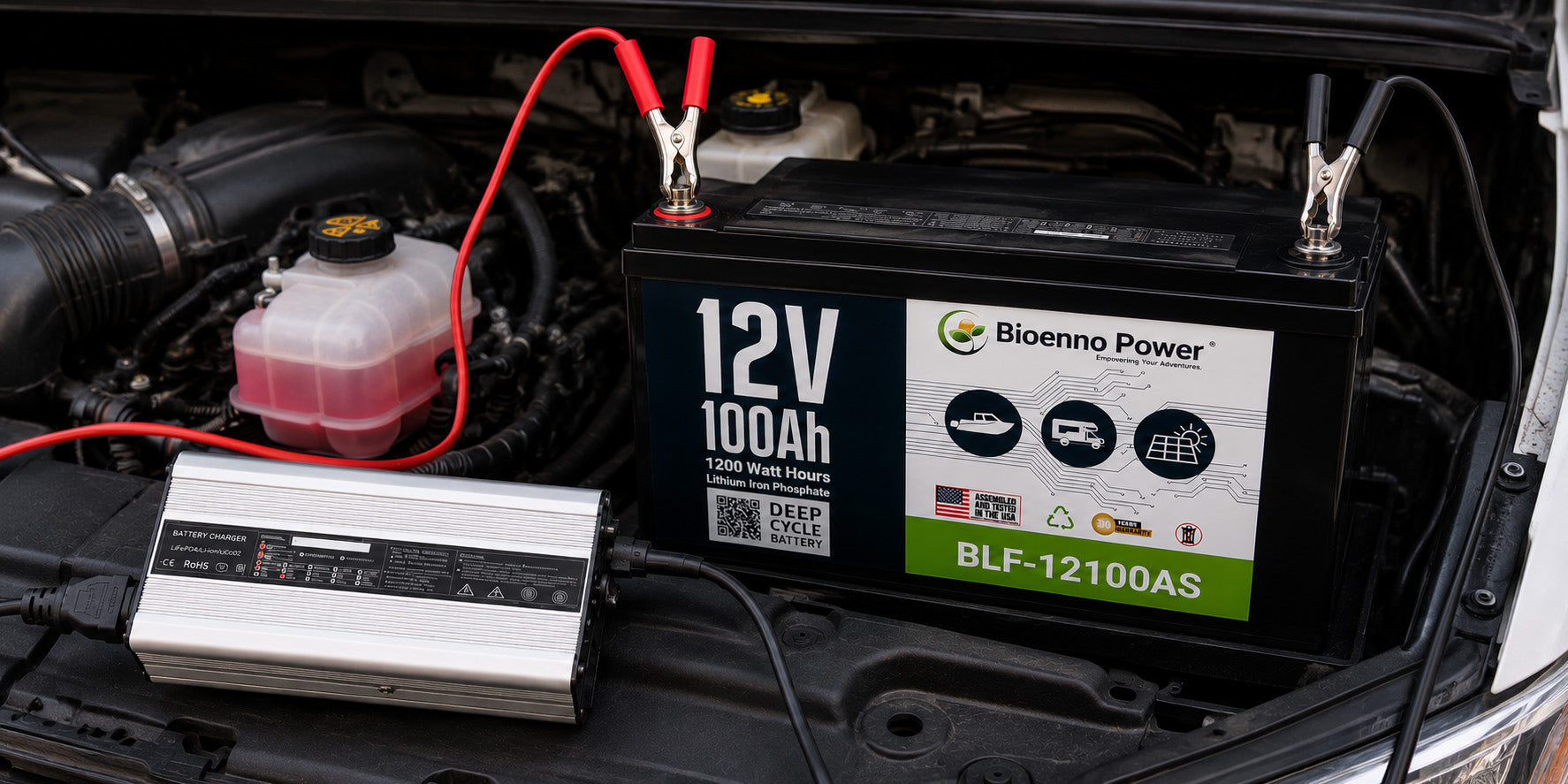
A charger is the device. The charging profile is how that device behaves. Many chargers can charge multiple battery types but only if you select the right mode. If the charger is in the wrong mode, it may still appear to work, but it can charge too aggressively, charge too slowly, or never fully charge at all.
Why LiFePO4 is different from lead acid
Lead acid batteries use a charging process that often includes a more extended absorption and float approach. Lithium iron phosphate is different. It charges efficiently, holds voltage differently, and generally does not want to be treated like a flooded or AGM battery.
If you are coming from lead acid, it is normal to assume a charger that worked before will work now. Sometimes it will. Sometimes it will not. The goal is to confirm, not guess.
For a deeper technical explanation of lithium charging behavior and voltage stages, see this Battery University overview.
What goes wrong when the profile is wrong
When the charging profile is wrong, you may notice inconsistent runtime later in the day, a battery that never seems to reach full, or a battery that trips protection unexpectedly when charging systems and loads do not play nicely together. Sometimes the frustration is not the battery at all. It is the profile.
Example: If your lithium battery seems full after a short charge but runtime drops fast, the charger may be finishing early in an AGM mode. Switching to a true LiFePO4 profile and letting a full cycle complete often fixes the issue (assumption based on common user setups).

How to confirm your charger uses the right LiFePO4 charging profile
The simplest rule is this: Do not assume the label on the charger means it is configured correctly today. Confirm the mode every time you change chargers, wiring, or power sources.
The easiest checks you can do before you plug in
Start with these checks:
- Find the charger manual or product page and look for an explicit LiFePO4 or lithium mode.
- Confirm you can select that mode and it stays selected.
- If the charger has a display, verify the mode is shown on screen.
- If the charger uses an app, confirm the battery type is set to lithium and the profile is applied.
Common charger modes that cause confusion
These mode labels often lead to mistakes:
- AGM mode. Many people assume AGM is close enough to lithium. It usually is not.
- Reconditioning or desulfation modes. These are for lead acid maintenance. Do not use them for lithium.
- Auto detect mode. Auto detect can fail depending on the charger design and the battery state.
If your charger forces one of those modes, it may not be a great match for LiFePO4 charging.
When a charger is not a good fit
A charger may not be a good fit if it has no lithium profile, cannot keep lithium mode selected reliably, runs hot or behaves inconsistently, or is simply sized wrong for your battery and use pattern (assumption because exact specs vary by model). If you want to standardize with one source of truth, a practical starting point is to compare Bioenno LiFePO4 battery chargers by voltage and connector type.
Safe charging at home and in the garage
Home charging is where most people can lock in long term reliability. It is also where most mistakes happen because it feels routine.
A simple routine for day to day charging
A practical routine is simple. Charge in a consistent place with stable power, use a charger set to the LiFePO4 profile, and let the charger complete its cycle. If your system is not designed to stay connected continuously, disconnect after the cycle is complete (assumption because setups vary). The key point is that you are trying to create a repeatable system. A repeatable charging routine beats a perfect charging theory.
Storage charging and seasonal downtime
If your boat, RV, or power kit sits for a while, storage matters. Many people either store fully full or fully empty. Neither is ideal in most real world situations.
A better approach is to store at a reasonable state of charge and check it on a schedule. If you want a broader mindset on upgrading from lead acid to LiFePO4 and what to expect across use cases, the Bioenno lead acid to LiFePO4 upgrade guide is a good starting point.
What to watch for on temperature and ventilation
Lithium charging should be treated with the same basic respect as any electrical gear. Charge in a dry, protected spot, keep cords and connectors in good shape, and avoid charging in extreme heat or cold without checking product specific guidance (assumption because temperature guidance depends on the specific product specs). A clean cable connection and a charger that stays in lithium mode do more for reliability than most people realize.

Charging on the boat in the vehicle or at camp
Charging away from home is where systems get more complex. You may have alternators, shore power, solar, inverters, and multiple loads all competing.
Alternator charging and DC to DC charging basics
Vehicle and boat alternators can be great sources of charge, but they are not always designed to behave like a lithium charger. In many builds, a DC to DC charger is what creates a stable lithium friendly charging profile (assumption because vehicle and boat systems vary widely). If you are running a simple weekend setup and want to sanity check battery sizing and expectations, the Bioenno guide for choosing a battery for a weekend off-grid trip is useful context.
Shore power and campsite power considerations
Shore power is convenient, but it is only as good as the charger behind it. Treat shore power like a wall outlet at home, but verify your charger is in lithium mode, your cords and adapters are sized appropriately, and your charging location is dry and safe. If you also charge from solar, make sure your solar charge controller supports LiFePO4 profiles or settings.
Keeping your trolling motor battery and house loads separate
If you fish and also run house loads, one of the easiest ways to create problems is combining everything into one battery without planning. In many setups it is cleaner to dedicate one battery or bank to the trolling motor and a separate battery for electronics and accessories (assumption because each build is different).
If your use case includes trolling motor systems, the Bioenno Minn Kota Quest battery setup article can help frame the conversation even if your exact setup differs.
Mistakes that cause inconsistent performance and early battery problems
Most of the frustration stories come down to a handful of avoidable mistakes.
Mixing battery types or ages
Do not mix lead acid and lithium in the same system unless you know exactly what you are doing. Also avoid mixing old and new batteries in a bank. Consistency in the bank matters.
Undercharging overcharging and chasing 100 percent all the time
People often assume the battery must always be at 100 percent to get the benefit. In reality, your goal is stable, safe performance and longevity. If your charger and usage pattern are fighting each other, you can end up with a battery that seems unreliable even when it is healthy.
Ignoring wiring and connector losses
A perfect charging profile cannot fix poor wiring. Loose connections, undersized cables, and corroded terminals create voltage drop and heat. That can show up as performance issues that feel like a battery issue but are really a system issue.
Choosing a Bioenno charging setup and what to do next
If you want your lithium upgrade to feel like an upgrade, the next step is to make your charging predictable.
A practical checklist before you buy
Use this checklist:
- Confirm your charger supports a real LiFePO4 charging profile
- Confirm the mode is selectable and stays selected
- Confirm your wiring and connectors are sized and secure
- Decide where charging will happen most often
- Decide whether you need shore power, alternator charging, or both
When to upgrade chargers or add monitoring
Upgrade or add monitoring when you cannot confidently confirm the charging mode, when you charge from multiple sources and need consistent behavior, or when you see performance swings that do not match your usage.
Shop now and keep your power setup dependable
When you are ready to standardize your setup, start with Bioenno products that match your use case and build from there. A quick way to start is to compare Bioenno LiFePO4 battery chargers by voltage and connector type. If your use case is fishing and boating, it can also help to browse batteries that are designed for marine setups like trolling motors and fish finders. For additional charging and setup context, you can also explore the Bioenno blog archive.